Identification guide
From the authors:
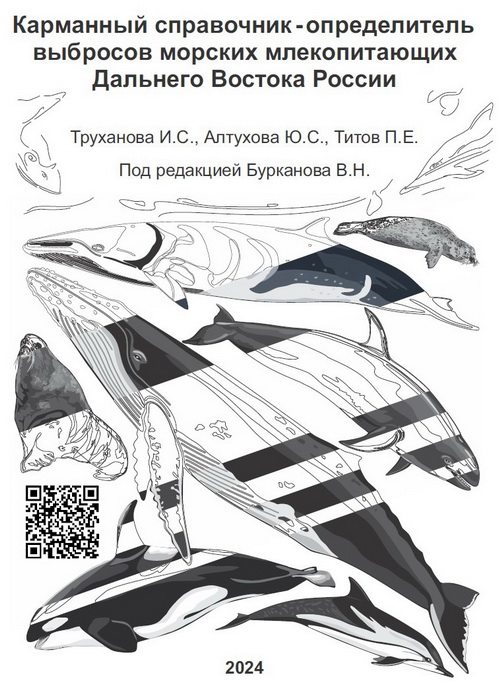
Presented here is a guide to marine mammals, designed to help identify the species of dead animals found along the coasts of the Far East seas. It will be useful for residents of coastal areas in Russia, tourists, travelers, fishermen, naturalists, and all those who happen to visit the shores of the seas that wash the eastern edge of our country.
We hope that with your help, scientists and environmental organizations will receive additional information about the state of populations of these animals, and that this guide will help expand your knowledge of marine life and contribute to the study and conservation of marine mammals. The compilers of the guide express their deep appreciation to the authors of the photographs and the specialists involved in the development and maintenance of the unified Marine Mammals Encounter Database.
Marine mammals sit at the top of the ocean’s trophic pyramid and play an important role in the functioning of marine ecosystems. They consume significant amounts of aquatic biomass, participating in the dynamic processes of energy cycling in the ocean. Their distribution, seasonal migrations, and population size largely depend on the abundance and spatial distribution of their food sources, which in turn are influenced by living organisms at lower trophic levels.
Therefore, any changes in the ocean’s trophic pyramid reflect the state and well-being of marine mammals. If these changes are positive, the population of marine animals increases; if they are negative, mortality rises, and the number of dead animals washed ashore increases. Thus, marine mammals act as indicators of the health of the ocean. This role of marine mammals as indicators of ocean health is poorly studied.
By collecting and reporting information about encounters with live or dead animals, you can provide invaluable assistance to scientists and specialists engaged in their study and conservation.